
Supporting Equipment & Consumables
Raw Materials
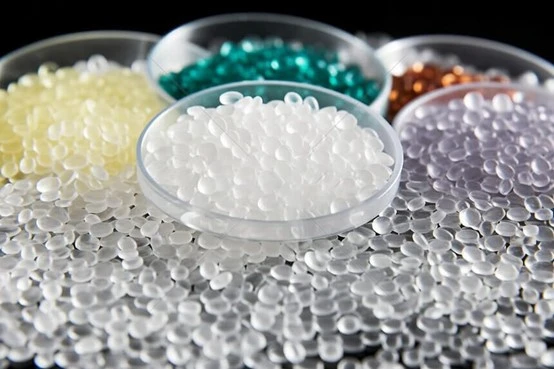
Plastic pellets and color masterbatch used for injection molding production.
Product Description
Raw Materials for Injection Molding Machine
Pelletized raw materials, also called plastic pellets, are the most basic material foundation of injection molding. They are usually processed into uniformly sized small pellets to ensure smooth flow and uniform heating in the injection molding machine.
Based on their properties after heating, they can be divided into two categories:
| Type | Characteristics | Representative Materials |
|---|---|---|
| Thermoplastics | They soften when heated and harden when cooled. This process can be repeated, so they can be recycled and reused; they are the most commonly used type in injection molding. | PP (polypropylene): The most common, widely used, with good chemical resistance. PE (polyethylene): Hard or soft depending on density. ABS: High strength and good toughness, often used for appliance housings. PC (polycarbonate): High transparency and impact resistance, used for spectacle lenses, etc. PA (nylon): Wear-resistant and heat-resistant, used for gears and bearings. |
| Thermosetting Plastics | After heat curing, their chemical structure changes and they cannot be melted again; their molding process differs from that of thermoplastics. | Epoxy resin, phenolic resin, etc. |
Raw Materials (Color Masterbatch)
Color masterbatch is an efficient plastic colorant. It comes in pellet form rather than powder, making it cleaner and more convenient during mixing and use.
Composition and function: Color masterbatch is essentially a concentrated mixture of pigment (50–60%) and resin carrier (40–50%). During injection molding, only a small amount of color masterbatch needs to be mixed with a large quantity of natural-color pelletized raw materials to color the product uniformly.
More than color: In addition to providing color, there are various functional masterbatches that can add special properties to products:
Advanced process applications: In some special processes, by controlling the size and melting point of color masterbatch, it can remain not fully melted during injection molding, thereby forming unique marble or flow-mark textures on the product surface for decoration.
During injection molding, pelletized raw materials and color masterbatch are first mixed evenly in a mixer at a certain proportion (color masterbatch usually accounts for 1%–10%, depending on the specific requirements). The mixture is then fed into the injection molding machine, where it is heated, melted, mixed, injected, and finally molded into a product with both the desired color and designed performance.